
FAMILY PLANNING & CONTRACEPTION IN CENTURION SINCE 1998
Family Planning & Contraception
Many women receive incorrect information about contraception from social media, friends or online discussions. The truth is that different contraceptive methods work in different ways, and the best option depends on your individual body, lifestyle, medical history and future pregnancy plans.
At Reproductive Choices SA in Centurion, we offer confidential family planning consultations to help women choose safe, effective contraception suited to their personal needs.
Our experienced medical team offers professional advice on:
- birth control pills and patches (6 month script R140)
- contraceptive injections (2 month and 3 month R190)
- Mirena (insertion excluding device R1800)
- Kyleena (insertion excluding device R1800)
- Avibela (insertion excluding device R1800)
- Copper T / IUCD (insertion including device R2000)
- side effects and safety
Bookings are essential.
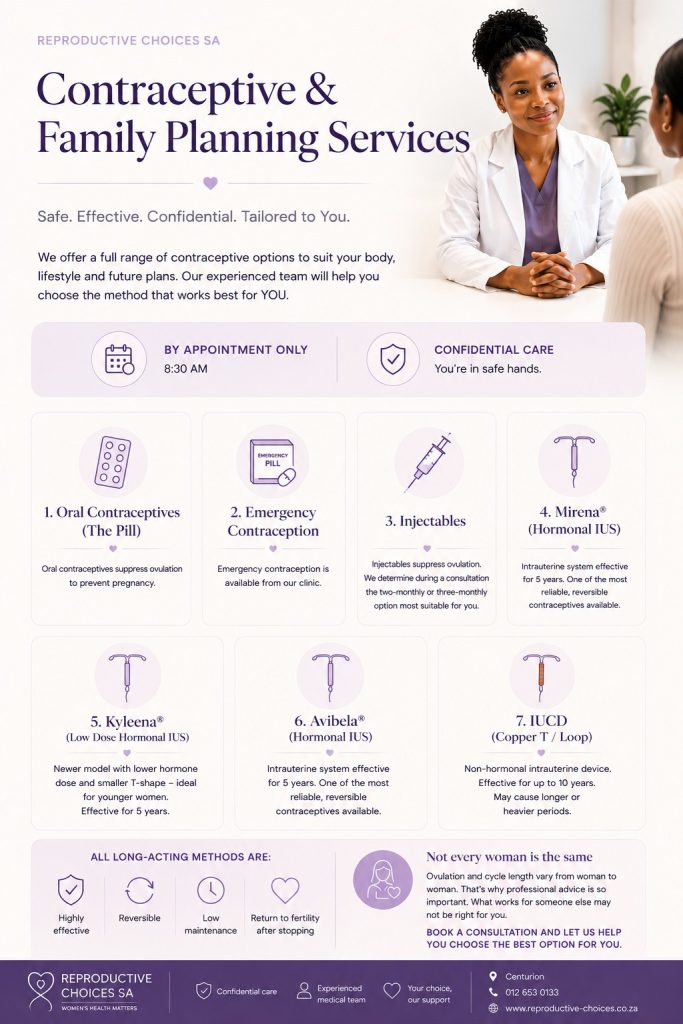
Which method of birth control will suit you best?
| Method | Duration | Hormonal | Best For |
| Pill | Daily | Yes | Short-term |
| Injection | 2–3 months | Yes | Convenient |
| Mirena | 5 years | Yes | Long-term |
| Kyleena | 5 years | Yes | Younger women |
| Avibela | 8 years | Yes | Long-term |
| Copper T | 10 years | No | Hormone-free |
Myths and Misconceptions About Contraceptives
Does the contraceptive injection make you gain weight?
Hormonal contraceptives that contain progesterone may increase appetite in some women. Weight gain is usually related to increased calorie intake rather than the injection itself.
Does the contraceptive injection cause infertility?
No. The contraceptive injection does not cause infertility. However, it may temporarily delay the return of regular menstrual cycles and fertility after stopping treatment. In some women, periods may take 6 to 9 months to return to normal.
Is it dangerous if I do not get a period while using the injection?
No. The progesterone in the injection prevents the lining of the uterus from building up. Because there is little or no lining to shed, many women stop having periods while using the injection. This is not dangerous and there is no blood “collecting” inside the body.
Can the injection cause headaches, mood swings or loss of libido?
These side effects can occur in some women, but they are relatively uncommon and usually mild. Most women do not need to stop using the injection because of these symptoms.
The Pill
Are the chemicals in the contraceptive pill harmful?
No. The hormones used in contraceptive pills are similar to the natural hormones already produced by a woman’s body. These hormones are processed by the body and work in the same way as natural oestrogen and progesterone.
Can the contraceptive pill help with other medical conditions?
Yes. Many contraceptive pills may help improve:
• Acne
• Irregular periods
• Painful periods
• Heavy menstrual bleeding
• Ovarian cysts
• Fibroids
• Bladder infections
• Lumpy breasts
Some hormonal contraceptives may also reduce the risk of certain reproductive health conditions.
Does the pill make you gain weight?
Some women may experience increased appetite while using hormonal contraception. Weight gain is usually related to eating habits and lifestyle rather than the pill itself.
The IUD / Copper T
Does the IUD cause ectopic pregnancy?
No. Women using an IUD generally have a lower risk of ectopic pregnancy compared to women using no contraception at all.
Does the IUD cause infections?
No. Infections are caused by microorganisms and sexually transmitted infections — not by the intrauterine device itself.
Can teenagers use an IUD?
Yes. There is no specific lower age limit. IUDs can be suitable for sexually active women of different ages following medical assessment.
Mirena, Kyleena and Avibela IUD
Does Mirena, Kyleena or Avibela cause continuous bleeding?
Hormonal IUDs such as Mirena, Kyleena and Avibela may initially cause irregular bleeding after insertion. Over time, bleeding usually becomes lighter and may eventually stop completely within 3 to 6 months.
Do hormonal IUDs increase the risk of ectopic pregnancy?
No. Women using Mirena, Kyleena or Avibela generally have a lower risk of ectopic pregnancy compared to women using no contraception.
Do Mirena, Kyleena or Avibela cause infertility?
No. Fertility usually returns quickly after removal of the device. Hormonal IUDs do not cause infertility.
What is one of the most common causes of tubal infertility?
Tubal infertility is commonly associated with untreated sexually transmitted infections, especially Chlamydia infections.
Do hormonal IUDs cause infections?
No. Infections are caused by bacteria or other microorganisms, not by the device itself.
Can teenagers use Mirena, Kyleena or Avibela?
Yes. Hormonal IUDs can be suitable for sexually active women of different ages depending on individual medical assessment.
Are Mirena, Kyleena and Avibela expensive?
Although the initial insertion cost may seem high, these devices are long-acting contraceptives effective for up to 5 years. When divided over the lifespan of the device, the monthly cost becomes relatively affordable compared to many short-term contraceptive methods.
When Certain Contraceptives May Not Be Suitable
Some contraceptive methods may not be suitable for every woman depending on medical history, current health conditions and lifestyle factors. A confidential medical consultation and assessment are important before starting any contraceptive method.
When The Pill May Not Be Suitable
The contraceptive pill may not be recommended if you:
- Are pregnant
• Smoke cigarettes
• Have unexplained vaginal bleeding
• Have absent menstrual periods without medical diagnosis
• Have breast cancer or cancer of the uterine lining (endometrium)
• Have a personal or family history of heart disease or blood clotting disorders
• Suffer from migraine headaches
• Have liver disease
• Have certain blood disorders such as:
- Polycythaemia
- Sickle-cell anaemia
- Leukaemia
When Injectable Contraception May Not Be Suitable
Injectable contraception may not be recommended if you:
- Are pregnant
• Have unexplained vaginal bleeding
• Only require short-term contraception
• Have liver disease
• Suffer from migraine headaches
• Have uncontrolled diabetes
• Suffer from severe depression
• Have porphyria
When An IUD Or Copper T May Not Be Suitable
An intrauterine contraceptive device (IUD / Copper T) may not be recommended if you:
- Are pregnant
• Have unexplained vaginal bleeding
• Have a current pelvic infection
• May have cancer of the cervix or uterus
• Have a history of ectopic pregnancy
• Are HIV positive without medical management and assessment
Important Medical Advice
Every woman’s body and medical history are different. The safest and most effective contraceptive method should always be determined during a professional medical consultation.
At Reproductive Choices SA, our experienced medical team will help you choose a contraceptive option that is safe, effective and suited to your individual reproductive health needs.